
Boosting Forex Cash order success by 17% through UPI Split payments
Boosting Forex Cash order success by 17% through UPI Split payments
Designing a payment experience based on UPI for large value orders of (₹1 lakh+) Foreign currency (forex cash) to improve order success rate.
My role
My role
Mobile & Web UI design
Competitors research
Usability testing
Team
Team
Tushar Prakash (PD)
Subhanjali Gupta (PM)
Varun Vashisht (GPM)
Key metric
Key metric
Order success rate (conversion)

Overall business impact
Overall business impact
Order success rate of Foreign currencies increased by
17%
17%
Net Banking usage as pay method for orders exceeding ₹1 lakh reduced by
55%
55%
Let’s now understand how we achieved these results...
Let’s now understand how we achieved these results...
BACKGROUND
BACKGROUND
We offer foreign currency for International travellers and our conversion funnel was highly optimised for Avg. order value (AOV) of ₹55k with Avg. 165 daily orders and 88% order under ₹1 Lakh, where the seamless experience of UPI drove consistent week-on-week growth.
We offer foreign currency for International travellers and our conversion funnel was highly optimised for Avg. order value (AOV) of ₹55k with Avg. 165 daily orders and 88% order under ₹1 Lakh, where the seamless experience of UPI drove consistent week-on-week growth.
As peak travel season began, we observed a shift in our order distribution:
65% of orders: Remained under ₹1 Lakh (the optimized flow)
35% of orders: Exceeded ₹1 Lakh (averaging 404 orders per week)
While this 35% segment represented a significant opportunity for growth, it exposed a critical friction point: the standard UPI limit prevented these high-value users from completing their journey.
As peak travel season began, we observed a shift in our order distribution:
65% of orders: Remained under ₹1 Lakh (the optimized flow)
35% of orders: Exceeded ₹1 Lakh (averaging orders per day)
While this 35% segment represented a significant opportunity for growth, it exposed a critical friction point: the standard UPI limit prevented these high-value users from completing their journey.
What was the problem?
What was the problem?
What was the problem?
#1
UPI Ceiling
Convenient payment method was suddenly unavailable for our most valuable orders
#2
Net Banking “Dead End”
Users were forced to use high friction Net Banking flow but our payment integration did not support major banks (SBI, HDFC, Axis, and ICICI) for NB
What did it cost us?
What did it cost us?
Direct impact on the Order Success Rate (OSR), causing lost revenue from dropped transactions.
Surge in Customer Support (CS) tickets. High intent users (spent time uploading documents and adding details) started reaching out as they were blocked.
Direct impact on the Order Success Rate (OSR), causing lost revenue from dropped transactions.
Surge in Customer Support (CS) tickets. High intent users (spent time uploading documents and adding details) started reaching out as they were blocked.
How did the team discover problem?
How did the team discover problem?
Week on week funnel analysis
Customer queries
Week on week funnel analysis
Customer queries
How do users typically pay to buy cash?
How do users typically pay to buy cash?
How do users typically pay to buy cash?
Every transaction requires a mandatory Penny Drop verification to authenticate and whitelist the user’s bank account. Only after this, the user can choose between UPI or Net Banking as their payment instrument.
Every transaction requires a mandatory Penny Drop verification to authenticate and whitelist the user’s bank account. Only after this, the user can choose between UPI or Net Banking as their payment instrument.

What did we conclude...
What did we conclude
What did we conclude...
By leveraging the familiarity of UPI, we introduced UPI Split Payment as a high-impact solution to bridge the conversion gap”.
By leveraging the familiarity of UPI, we introduced UPI Split Payment as a high-impact solution to bridge the conversion gap”.
How does UPI Split payment fit in to the system?
How does UPI Split payment fit in to the system?
How does UPI Split payment fit in to the system?
Where do we show
Where do we show
Between flow’s last screen (Delivery details) and Penny drop verification.
Between flow’s last screen (Delivery details) and Penny drop verification.

Whom to show
Whom to show
Users with order value greater than ₹1 Lakh.
Users with order value greater than ₹1 Lakh.
How does it work
How does it work
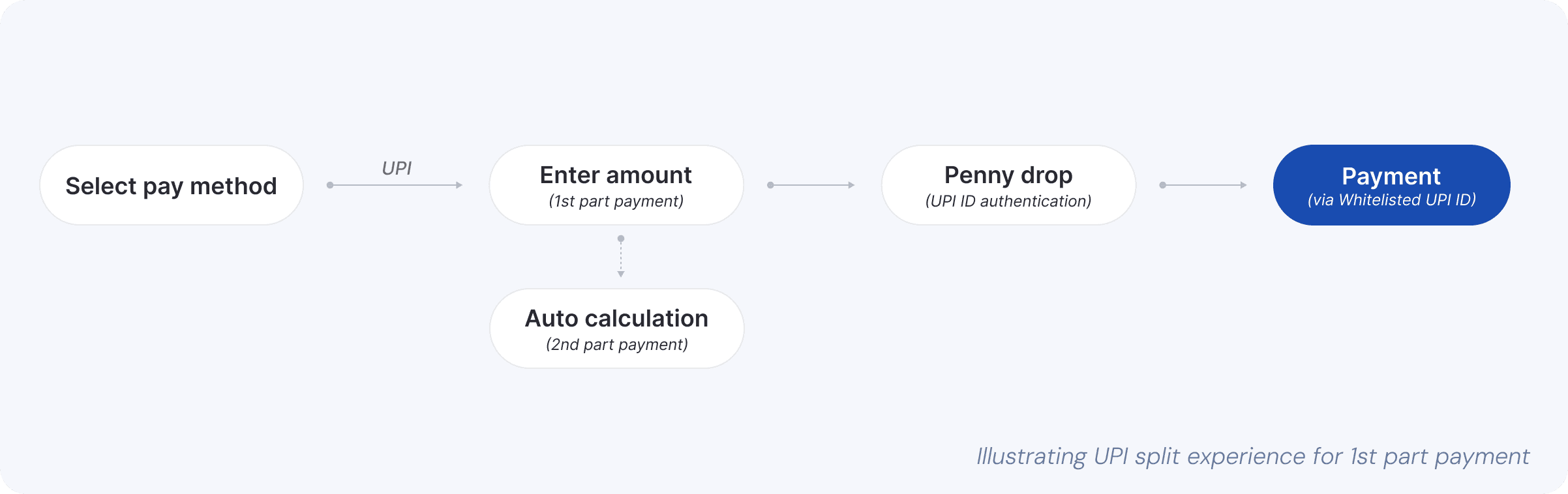
Flexible Payment options:
Two separate UPI transactions, with the flexibility to choose amount for the payment.
Flexible Payment options:
Two separate UPI transactions, with the flexibility to choose amount for the payment.

What were the foreseen challenges
What were the foreseen challenges
#1
Mapping user scenarios to define a communication strategy, ensuring the right messaging reached users at the right time to drive conversion.
Mapping user scenarios to define a communication strategy, ensuring the right messaging reached users at the right time to drive conversion.
#2
How can we create a delightful, intuitive experience for this new concept that builds user trust and eliminates hesitation at critical touch points.
#3
Time was a major constraint on this high-priority business item, we leaned into a 'sketch-first' strategy. This allowed us to align on the UX logic and structure first.
Getting to the execution
Getting to the execution
Getting to the execution
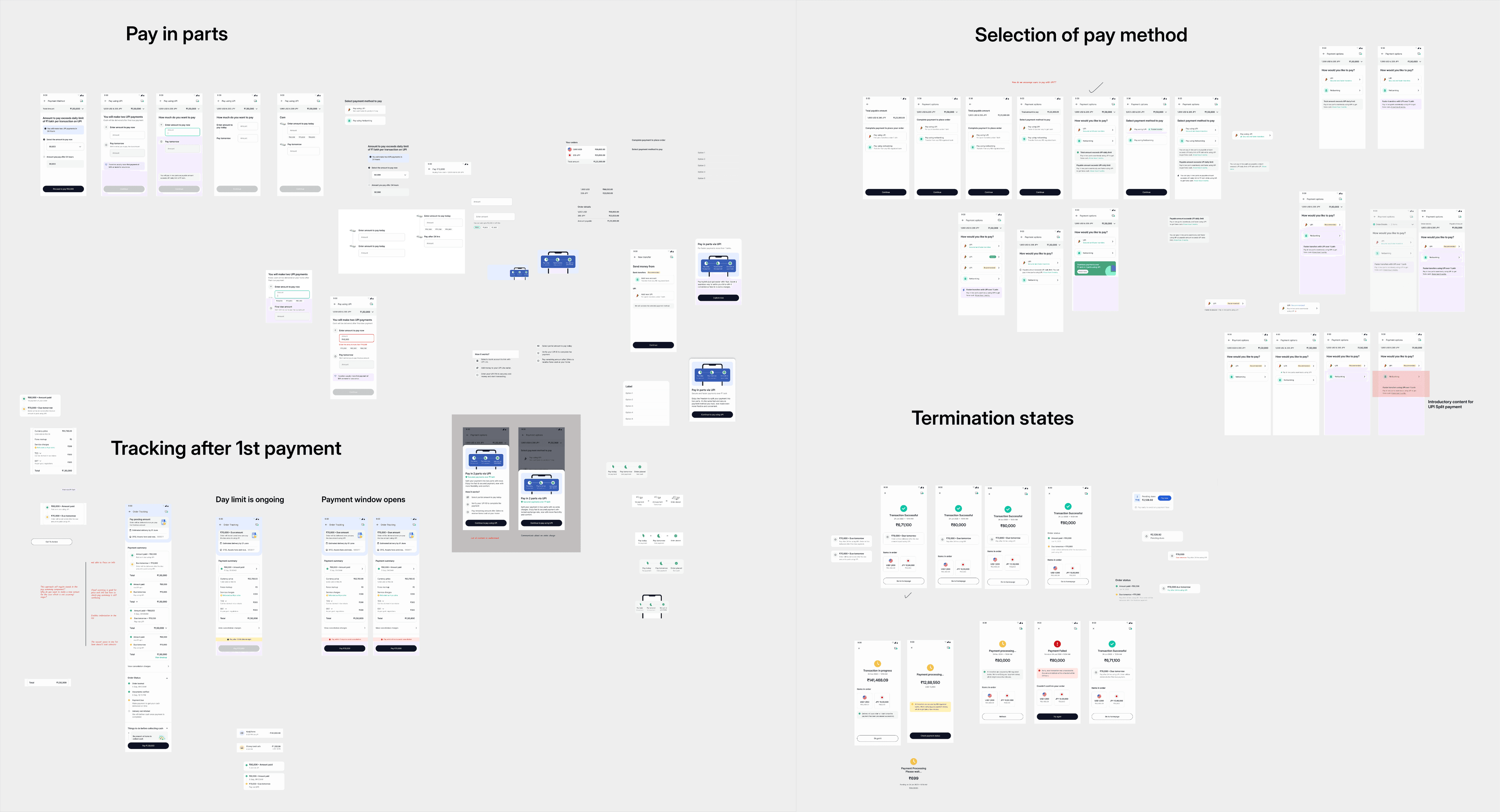
We started by benchmarking penny-drop implementations, BNPL and EMI experiences.
We started by benchmarking penny-drop implementations, BNPL and EMI experiences.
Initial ideas using generative AI tools
Initial ideas using generative AI tools
Our goal was to audit these generated concepts against our existing mental models and core screen constructs.
Specifically, we measured how well each idea integrated with current navigation patterns to ensure the new feature felt like a natural evolution rather than a disruptive addition.
Our goal was to audit these generated concepts against our existing mental models and core screen constructs.
Specifically, we measured how well each idea integrated with current navigation patterns to ensure the new feature felt like a natural evolution rather than a disruptive addition.
Why did we use Google AI studio: Interactive validation rather than just discussing over screenshots/sketches.
Why did we use Google AI studio: Interactive validation rather than just discussing over screenshots/sketches.


How paying via UPI Split looks
How paying via UPI Split looks
How paying via UPI Split looks
(1st part payment)
(1st part payment)

Involving team for feedbacks
Involving team for feedbacks
Since this was a new concept for payment, we thought to get first level of feedback from the design team.
Since this was a new concept for payment, we thought to get first level of feedback from the design team.
What they liked:
Visual Clarity: The banner on the introductory UPI Split bottom sheet provided immediate context.
Reduced Cognitive Load: Pre-defined selection chips allowed users to decide their first payment amount effortlessly.
What they liked:
Visual Clarity: The banner on the introductory UPI Split bottom sheet provided immediate context.
Reduced Cognitive Load: Pre-defined selection chips allowed users to decide their first payment amount effortlessly.
What they didn’t like:
Logic Sequence: Few users expected the "amount split" screen immediately after the Penny Drop verification.
Blind Daily Limits: There was no visibility into the user’s remaining daily UPI bank limit.
What they didn’t like:
Logic Sequence: Few users expected the "amount split" screen immediately after the Penny Drop verification.
Blind Daily Limits: There was no visibility into the user’s remaining daily UPI bank limit.
Improvements after the feedback
Improvements after the feedback
We introduced social proof nudges to build trust and drive higher upfront payments
(50%+).
To build awareness of UPI daily limits, we introduced a contextual info in bottom sheet prior to the payment stage.
Now, the biggest constraint wasn’t Tech, It was Trust.
We had to design a experience that felt like one continuous journey rather than two separate, disconnected payments.
Now, the biggest constraint wasn’t Tech, It was Trust.
We had to design a experience that felt like one continuous journey rather than two separate, disconnected payments.
Paying due amount to confirm the order
Paying due amount to confirm the order
Paying due amount to confirm the order
(2nd part payment)
(2nd part payment)
Following the 1st part payment, users have two paths:
Immediately settle the remaining amount to confirm their order
Drop off from the flow and pay the balance amount later
Following the 1st part payment, users have two paths:
Immediately settle the remaining amount to confirm their order
Drop off from the flow and pay the balance amount later

Another hurdle while designing was updating our existing UI screens to accommodate new states and logic without breaking the core user experience.
Another hurdle while designing was updating our existing UI screens to accommodate new states and logic without breaking the core user experience.
So, that’s how we scaled our flow screens
So, that’s how we scaled our flow screens
Introduced strategic refinements to the existing interfaces
Introduced strategic refinements to the existing interfaces

Solving for edge cases
Solving for edge cases
Solving for edge cases
A lot of questions came to mind during this time, such as:
what do we do if a user fails to pay the due payment within the given time?
What happens to the first payment?
What if the payable amount changes due to a change in the exchange rate?
A lot of questions came to mind during this time, such as:
what do we do if a user fails to pay the due payment within the given time?
What happens to the first payment?
What if the payable amount changes due to a change in the exchange rate?
One challenging limitation we encountered from Compliance team was,
One challenging limitation we encountered from Compliance team was,
Users must repay the full amount if they fail to complete the due payment (2nd part) within the allotted time.
Users must repay the full amount if they fail to complete the due payment (2nd part) within the allotted time.
Let’s see how we figured out those experiences:
Let’s see how we figured out those experiences:
Case 1: Failed to pay due amount in time but order has not expired
Case 1: Failed to pay due amount in time but order has not expired
Conclusion: Refund will be initiated for 1st part and user need to repay full amount
Conclusion: Refund will be initiated for 1st part and user need to repay full amount
Constraint #1
Constraint #1
Initially, we thought of showing the status info bottom sheet to establish context for returning users
Initially, we thought of showing the status info bottom sheet to establish context for returning users
Constraint #2
Constraint #2
While our refund component was built to be scalable, we faced a technical limitation—the backend could not provide complete refund details
While our refund component was built to be scalable, we faced a technical limitation—the backend could not provide complete refund details
Case 2: Failed to pay due amount in time and order has also expired
Case 2: Failed to pay due amount in time and order has also expired
Order couldn’t be fulfilled and user has to place a new order
Order couldn’t be fulfilled and user has to place a new order
Case 3: Order verification failed after paying the due amount
Case 3: Order verification failed after paying the due amount
Refund for 1st & 2nd part payment will be initiated and user has to place a new order
Refund for 1st & 2nd part payment will be initiated and user has to place a new order
In rare cases where automated Penny Drop fails before payment, we trigger a manual fallback: users upload a cancelled cheque for name verification.
If manual verification also fails, the transaction is rejected and a full refund is initiated.
In rare cases where automated Penny Drop fails before payment, we trigger a manual fallback: users upload a cancelled cheque for name verification.
If manual verification also fails, the transaction is rejected and a full refund is initiated.
What’s the next step?
What’s the next step?
What’s the next step?
We internally tested the end-to-end Forex Cash and UPI-split flow, focusing on comprehension and anxiety reduction to ensure the journey felt secure & intuitive.
We internally tested the end-to-end Forex Cash and UPI-split flow, focusing on comprehension and anxiety reduction to ensure the journey felt secure & intuitive.
Feedback / Result of testing
Feedback / Result of testing
Initial feedback highlighted a high 'interaction cost'—the current flow requires too many manual steps for the user to reach the payment stage.
They liked how we are utilizing a progressive disclosure model to ensure users felt guided rather than overwhelmed by the information.
How did it work?
How did it work?
How did it work?
(Post-release)
(Post-release)
UPI Split was deployed in mid-December 2025. Since then, the team has been actively monitoring adoption rates and success metrics to refine the experience for high-value transactions.
UPI Split was deployed in mid-December 2025. Since then, the team has been actively monitoring adoption rates and success metrics to refine the experience for high-value transactions.
UPI Split as preferrable method MoM growth for the first 3 months
UPI Split as preferrable method MoM growth for the first 3 months
UPI Split as preferrable
method
26.7%
Net Banking usage as pay method for orders exceeding ₹1 lakh reduced by
Net Banking usage as pay method for orders exceeding ₹1 lakh reduced by
55%
Funnel conversion for successful order above ₹1lakh reduced by
Funnel conversion for successful order above ₹1lakh reduced by
8%
Users reaching out to Customer support WoW reduced by
Users reaching out to Customer support WoW reduced by
80%
What could have been better?
What could have been better?
What could have been better?
A retrospective on opportunities for further optimisation and long-term product evolution:
A retrospective on opportunities for further optimisation and long-term product evolution:
The existing flow was already a high-intent, four-step process. Adding the UPI Split journey increased the total screen count, creating a risk of user fatigue ultimately leading to increase in funnel drop-off rate.
The existing flow was already a high-intent, four-step process. Adding the UPI Split journey increased the total screen count, creating a risk of user fatigue ultimately leading to increase in funnel drop-off rate.
Integrating the UPI Split payment method into the Penny Drop verification flow to create a unified journey. The sequence followed a logical progression:
Penny Drop → Bank Account Whitelisting → Amount Selection → Payment.
Integrating the UPI Split payment method into the Penny Drop verification flow to create a unified journey. The sequence followed a logical progression:
Penny Drop → Bank Account Whitelisting → Amount Selection → Payment.
Learning & Reflections
Learning & Reflections
Learning & Reflections
Designing for Trust in High-stakes: In money-sensitive designs, transparency is more important than anything. I learned that adding a small amount of friction like an extra confirmation step or a status banner actually increases user trust when dealing with large transaction volumes.
Designing for Trust in High-stakes: In money-sensitive designs, transparency is more important than anything. I learned that adding a small amount of friction like an extra confirmation step or a status banner actually increases user trust when dealing with large transaction volumes.
Moving beyond "visual thinking" to "system thinking”- I faced a lot of technical challenges during the project. I wasn't just designing screens; I had to build underlying logic frameworks.
Moving beyond "visual thinking" to "system thinking”- I faced a lot of technical challenges during the project. I wasn't just designing screens; I had to build underlying logic frameworks.
Data-Driven Iteration & Prototyping: Moving from static mockups to interactive models in Google AI Studio changed the team's internal discourse. It shifted the conversation from "how it looks" to "how it works," allowing us to catch logic gaps early in the discovery phase.
Data-Driven Iteration & Prototyping: Moving from static mockups to interactive models in Google AI Studio changed the team's internal discourse. It shifted the conversation from "how it looks" to "how it works," allowing us to catch logic gaps early in the discovery phase.
We made the whole experience for larger screen as well
We made the whole experience for larger screen as well

The true 'full-circle' moment for this project came in February 2026, during a trip to Thailand with friends. As I was the person responsible for ordering the group’s Forex cash, I found myself navigating the very UPI Split journey I had designed.
The true 'full-circle' moment for this project came in February 2026, during a trip to Thailand with friends. As I was the person responsible for ordering the group’s Forex cash, I found myself navigating the very UPI Split journey I had designed.
Thanks for scrolling to the end.
Thanks for scrolling to the end.
© 2026 Tushar Prakash